How to Develop Logical Thinking in Children: A Practical Guide for Ages 5–12
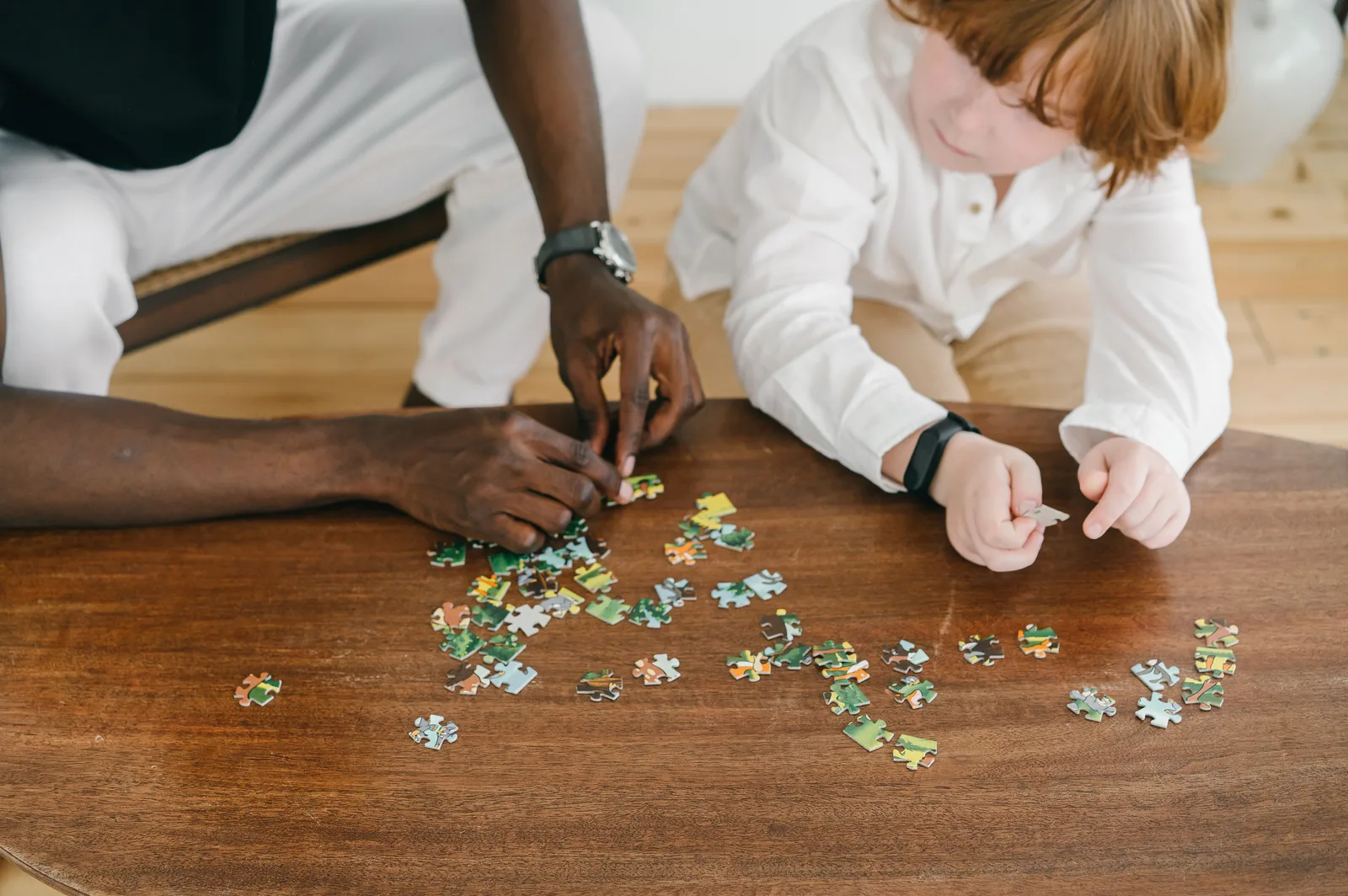
Logical thinking is not an innate talent — it is a skill that grows with practice. A child learns to separate cause from effect, a guess from evidence, and to finish the sentence “therefore…” correctly. None of this needs an expensive course or special materials: 15 minutes a day and the right questions are enough.
Below are exercises grouped by age, a weekly routine, and the mistakes parents make most often. Everything here works at home with paper and a pencil.
What logic means for a child
Adults hear “logic” and think of formal rules. For a child, logic is four simple actions:
- Comparing — how two things are alike and how they differ.
- Grouping — which property joins them: colour, shape, purpose.
- Sequencing — spotting a pattern and naming what comes next.
- Concluding — carrying an “if… then…” sentence to its end.
School mathematics rests on exactly these four. That is why logic practice pays off more broadly than arithmetic drills: it helps with reading comprehension, with breaking a problem into parts, and with arguing a point.
Ages 5–7: comparing and grouping
At this age a child cannot think abstractly yet — everything must be visible and touchable. Keep it a game, and keep it under 10 minutes.
- Find the odd one out.Five items, four from one group and one from another: apple, pear, grape, carrot, peach. After the answer, always ask “why?” — that is the real exercise.
- Continue the row. Red–blue–red–blue… then move to two properties: big circle, small square, big circle…
- Find the pair. Bird — nest, bee — …, fish — … This teaches relationships.
- Yes or no. You think of an object; the child asks only yes/no questions. Up to 20.
- What changed. Put out five objects, the child closes their eyes, you swap one.
At this age the explanationmatters more than the answer. “The carrot is the odd one because it is not a fruit” is already a logical argument.

Ages 8–10: patterns and conditional reasoning
The child can now work with “if… then…”. Exercises can be written, 15–20 minutes at a time.
- Logic grid.Three children, three sports, three clues: “Ali does not play football”, “Zuhra swims”… The child draws a grid and crosses out what cannot be true. This is the classic logic-puzzle format.
- True and false.“All birds can fly” — is it true? Show how a single counterexample (an ostrich) breaks the whole statement.
- The reverse-inference trap.“If it rains, the road is wet.” The road is wet — so did it rain? No: someone may have washed a car. Adults fall for this one too.
- Number patterns. 2, 4, 8, 16… and 1, 4, 9, 16… Ask them to explain the difference.
- Working backwards.“I picked a number, multiplied by 3, added 5, and got 20. What was it?”
Ages 11–12: proof and checking
Now the child should be able to justifyan answer. The question stops being “what is it?” and becomes “how do you know?”
- A feel for probability. How many outcomes do two dice have? Why does 7 come up most often?
- Counting. Five people each shake hands once — how many handshakes? (Ten, not twenty: each pair counts once.)
- Venn diagrams. In a class of 20, twelve play football, nine play chess, four do both. How many do neither?
- Algorithms. Write brushing your teeth as 10 steps. Then shuffle the steps and ask them to find the error.
A weekly routine: 15 minutes a day
Not much, but regular. Five days a week at 15 minutes clearly outperforms one hour once a week.
- Monday — patterns and sequences
- Tuesday — a logic grid or reasoning puzzle
- Wednesday — number games (working backwards, estimating)
- Thursday — “true or false” and counterexamples
- Friday — the child invents a puzzle for you
The last day is the most valuable: to build a puzzle, a child has to hold both the setup and the answer in mind at once.
Four mistakes parents make
- Giving the answer away. If you fill ten seconds of silence with the answer, the exercise loses its point. The pause is uncomfortable, but that is exactly where the thinking happens.
- Praising only correct answers.Instead of “well done, correct”, ask “how did you work it out?” A child praised for process does not avoid hard problems.
- Starting too hard.Three failures in a row and the child concludes “logic is not for me”. Drop the difficulty.
- Rushing. Logic rewards accuracy, not speed. A slow but justified answer is a good answer.
About practising online
A screen does not replace paper, but it complements it well — on one condition: an explanationmust appear after every answer. Without it, the session turns into a guessing game.
The logic courses on NextSuhbat are written for teenagers aged 12 and up and for adults: every question is followed by a full explanation, and the courses are free. For younger children, the exercises above, done together with a parent, are more useful.
Frequently asked questions
- At what age should a child start logic exercises?
- You can start at 4–5, but only as play: comparing, grouping, and “find the odd one out”. Written exercises suit children from about 7. Regularity matters more than age — 10 to 15 minutes a day is enough.
- How much time per day?
- Ten minutes for ages 5–7, fifteen to twenty for ages 8–10. Five short sessions a week beat one long hour, because the skill consolidates through repetition.
- What if the child cannot solve a puzzle?
- Do not give the answer. Simplify the question first, or split the setup into parts: “do we understand this bit?” If they fail three times in a row, the level is too high — go back to easier problems.
- Are online logic exercises useful?
- Yes, provided an explanation appears after every answer. Without it the session becomes a guessing game. Alternate screen work with exercises on paper.
Comments · 0 comments
Sign in to leave a comment or rating.
Sign in →No comments yet. Be the first to share your take.